

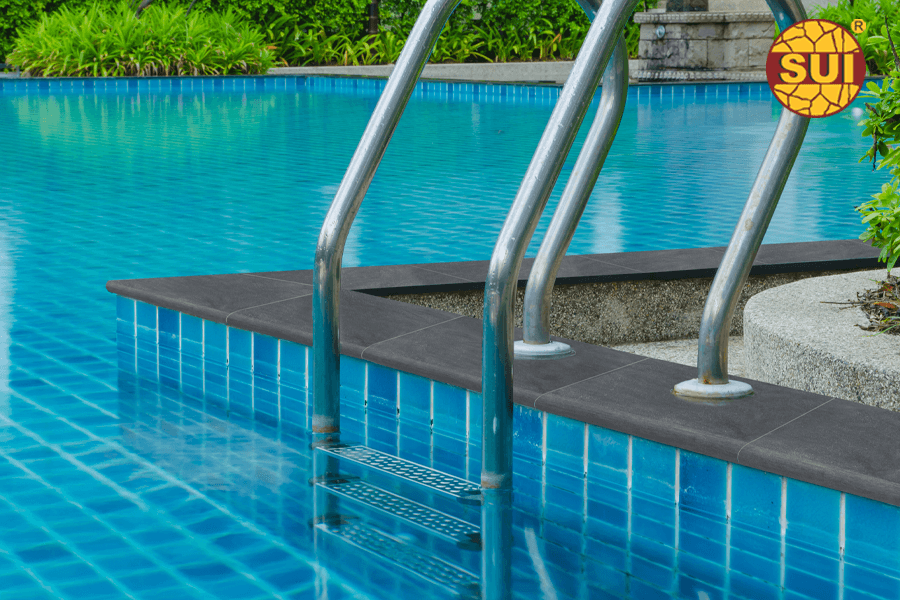
Organic pools appeal to designers and contractors who want to connect swimming areas with natural surroundings. These pools feature free-form shapes that resemble ponds or lagoons. Coping for such pools must follow curved and uneven edges while maintaining a natural appearance. Recent developments in bullnose coping provide effective solutions through rounded profiles that create smooth transitions from water to deck. Bullnose adds a textured, aged surface that supports this aesthetic. This article explains the role of bullnose in irregular pool coping, including material options, installation methods, and design strategies relevant to natural stone dealers, contractors, designers, and landscape architects.
Bullnose in Pool Coping Applications
Bullnose consists of rectangular stone units with a smooth, rounded edge on one long side and is always supplied with a naturally softened, tumbled finish. Professionals commonly specify it for pool perimeters, steps, and wall caps. The rounded edge improves safety by reducing sharp corners and helps guide water back into the pool. Standard bullnose coping suits rectangular pools with straight lines. Organic pools, however, require coping that adapts to irregular contours.
During production, bullnose units undergo a tumbling process that softens edges and creates a matte, weathered finish. This finish gives the stone an appearance shaped by natural elements over time. In irregular pool designs, bullnose accommodates varying radii and angles. The gently textured surface also delivers reliable grip in wet conditions, supporting safer movement around pool edges.
Bullnose coping is available in natural stones such as sandstone, limestone, and travertine. Sandstone offers warm colour variation that matures naturally with exposure. Limestone provides a more uniform appearance with subtle veining. Travertine introduces natural pores that enhance the organic feel. Porcelain versions replicate these appearances while delivering uniform dimensions and color matching across large quantities. Dealers can supply both material types to meet specific project requirements.
Approaches to Irregular Pool Edges
Irregular pool perimeters require coping units that conform to complex curves without visible gaps or overlaps. Bullnose supports this through standard lengths of 12 to 24 inches, which contractors can cut and fit on site. Waterjet cutting allows precise shaping of individual pieces to match the exact pool outline, reducing material waste and installation time.
A practical method involves dry-laid placement of bullnose, where the textured surfaces interlock without mortar. This approach maintains a clean, joint-free look preferred in organic designs. Varying unit thicknesses between 1 and 2 inches enable subtle level changes that mimic natural rock ledges.
On sloped sites, staggered rows of bullnose coping control surface runoff and prevent erosion. Combining bullnose with adjacent flagstone or decking creates continuous surfaces, as the rounded edge meets flat planes without abrupt transitions. Landscape architects often specify this combination for spillover edges, where bullnose directs water flow smoothly.
Porcelain bullnose performs well in environments exposed to pool chemicals, making it suitable for commercial or high-use installations where longevity is a priority.
Material Selection and Performance Factors
Material decisions for bullnose coping depend on project scope, budget, and site conditions. Natural stone provides authentic variation and thermal mass that keeps surfaces cooler in direct sunlight. Sandstone exhibits low absorption rates, which helps in regions with freeze-thaw cycles. Limestone develops a natural patina that enhances its appearance over time.
Porcelain bullnose incorporates advanced printing technology to achieve realistic stone patterns with minimal batch variation. This uniformity simplifies installation on extensive, irregular perimeters. Both materials achieve high slip-resistance values, with tumbled surfaces typically exceeding a friction coefficient of 0.6 in wet testing.
Structural tests confirm that bullnose supports distributed loads up to 500 pounds per square foot, adequate for typical poolside traffic and furnishings. Flexible adhesives accommodate minor substrate movement in curved sections, reducing the risk of cracking. Dealers maintain inventory in multiple sizes to allow quick adjustments during construction.
Installation Practices for Organic Pools
Successful installation of bullnose on irregular pools begins with accurate perimeter templating using digital measurement tools. This data guides piece layout and ensures consistent overhang, with fixed options of 1.5 inches or 2 inches, maintained uniformly along the entire pool edge.
Polymeric sand swept into joints provides stable support while permitting drainage, an approach well-suited to landscaped pool settings. For porcelain bullnose, thin-set mortar bonds securely to concrete substrates, facilitating upgrades of existing pools to organic forms.
Variable elevations are managed through adjustable shims placed beneath units. Hidden drainage channels installed under the coping direct water away without interrupting the visual line. Natural stone bullnose benefits from periodic sealant application to preserve color intensity.
Project examples demonstrate these practices. A residential lagoon-style pool used tumbled travertine bullnose along a winding edge integrated with native boulders. The forgiving tumbled profile reduced fitting time by approximately 20%. A commercial infinity-edge installation employed porcelain bullnose coping to maintain uniform appearance across an asymmetrical layout.
Expanded Design Applications
Bullnose extends beyond simple edging in organic pool projects. Stacked courses of thinner units form tiered ledges that resemble natural cascades. The rounded profiles allow safe plant overgrowth along the edges.
Strategic color selection creates gradual transitions, with darker tones near the waterline shifting to lighter shades farther out. This technique adds perceived depth to irregular pool shapes. Submerged benches finished with bullnose provide comfortable in-water seating.
Responsible sourcing of natural stone and water-efficient porcelain production align with sustainable project goals. Extending bullnose into adjacent walkways maintains textural continuity. Recessed lighting in joints highlights curves after dark while preserving safety.
In mixed-material designs, bullnose coping transitions to timber or composite decking, with the stone edge serving as a durable, slip-resistant boundary.
Conclusion
Bullnose offers practical advancements for irregular pool coping in organic designs. The combination of rounded edges and textured surfaces delivers safety, durability, and visual integration with natural landscapes. Professionals gain reliable options to execute complex pool perimeters that meet client objectives efficiently.
Stone Universe Inc. supplies a comprehensive range of bullnose coping in natural stone and porcelain to support these applications. Explore Stone Universe Inc. to review available products and specifications. Their resource assists natural stone dealers, contractors, designers, and landscape architects in selecting materials that help achieve successful project outcomes.
